Wednesday, 22 February 2012

Task 9. Filming

Second filming day, Sunday 19th February

When we came together this day, we had the plan ready. We were going to film scene three, our very last scene, where our second character, Tanya, played by Sophie Ravenscroft, was going to get brutally killed.
Picture from the scene
The location is Tamworth, and the setting is outside Chloe Ravenscroft's house. 
We chose this setting because we wanted a place with large towering trees that were leafless. This is beacause it gives a sense of isolation, by this we hoped to create a very eerie feeling, as nobody is around to call for, if you need help. This is something that is highly associated with the horror genre. 
Picture from the scene
Another reason for why we wanted an isolated place, was for us to shoot our film undisturbed. It was crucial for us that nobody was in the background at any time, as Tanya was suppose to be all alone while she gets killed. When Tanya gets killed, she is laying on her own doorsteep. We decided that we wanted her to die there to add a sense of sadness to the scene as she was so close to be safe. Being killed at your own doorsteep is also very wrong and twisted, as it is your home area, and the connotations for home is usually safety and warmth. By letting Tanya die there, we challenged a convention in order to corrospond with the horror genre.

In this scene we used a various different camera angles, amongst them: a normal medium shot, to show Tanya walking past the camera whilst talking in the phone, filmed from a tripod.
A close up at Tanyas face, to show her feelings after she gets the sense that someone is following her, it shows that she is scared, and a bit confused. This shot is also filmed from a tripod.
We also used a high angle whilst filming Tanya, this was to make her look weaker, and more powerless. This shot was also filmed from a tripod.
In one shot we used the technique by holding the camera ourself, giving a sense of uneasiness. This was also because it was from a subjective point of view. To be more accurate it was from Dolly's point of view, where she is watching Tanya from behind some branches.
We used another hand held, point of view shot from Dolly when she is running up to Tanya, this shot stops by Tanya screaming in a close up. 
When Tanya has been murdered by Dolly, we get a medium close up of Tanya laying on the ground, with the murder weapon next to her: the knife. As this shot goes on, a hand streches for the knife and grabs it. This is foreshaddowing that nothing is over yet.Which gives a horrifying feeling as it indicates that more people is about to die. 
The props used for this scene is a mobile phone, which Tanya uses in the beginning of the scene. 

One plastic knife, and one real knife. We used the plastic knife when Dolly Pocket is pretending to stab Tanya, as you can see on the picture to the right. This was to ensure that nobody would get injured if Dolly Pocket should have dropped the knife by accident. In the medium close up of Tanya laying dead on the ground with a knife next to her, we had switched the plastic knife out with a real knife. This was to make it look more real, and scary. If the audience saw that it was only a plastic knife that had been used, we would not get that horrifying effect we wanted.  
We also had to make fake blood, as Dolly would stab Tanya, and it would only be natural that it would come some blood out of it. 

The costumes used for this scene is a pair of blue trousers, a purple t-shirt and a white jacket for Tanya. This indicates that she is just a normal person, as the connotations to the white jacket is peacefulness and safety. 
The costume used to Dolly Pocket is the same as in scene one. She still have the green doll dress on, with white circles on it. This dress still gives a eerie feeling, as we think it is wrong for a grown up person to use such a dress, especially on this way.

Friday, 10 February 2012

Task 9. Filming

First filming day, thursday 9th February. 

On our first filming day we were all set to go to Chloe Ravenscroft's house, to get started. We had to make some changes from the production scheduale, but overall, the filming day turned out to be a great success, where we were able to finish both the opening scene, and the ending scene of our film.

The location for both the scenes was Tamworth, and the setting was inside of Chloe Ravenscroft's house, which in the film was suppose to be Dolly Pocket's house. The reason for why we chose this setting was because it was a standard middle class house, which would give a sense of realism to the film. The fact that both the opening scene and the ending scene were going to take place inside of the house, made it convenient for us to film it both on the same day.

Scene 1.
We were very eager to start filming, using the tripod and the camera that our school had provided us with. Before we could do that however, we had to decorate what which was suppose to be Dolly Pocket's living room, before she lost her child. We made the made the room very light, turning on every lamp in the room. We also had white curtains in the background. On this way we wanted to create a sense of safety, and make a typical home-feeling.
Dolly Pocket, in her home, holding her baby.
As we were filming we chose to film it in a 'home-made-video', were the character Dolly Pocket is looking into the camera, telling her 'husband' how beautiful their new born baby is. To make it more believeable that it was her husband she was talking to, we decided that she was going to ask her him this "Oh, isn't she beautiful Nigel?". On this way we could get a voiceover later on, of a grown up man saying "oh yes darling, she is", so it would seem like he had been there the whole time. 
The whole scene was filmed in a hand held camera, as this would give a sense of realism.
The costume used in this scene, are as you may can see on the picture above, a comfortable white sweater and some normal blue trousers. We chose the white sweater, as the connotations to white is pureness and innocence, this indicates that she is just a normal mother, where nothing dramatically has happened to her. The scene ends with the 'husband' throwing the camera down in a chair, so the audience can not really see what happens, as he is running over to his child, were Dolly Pocket is crying, because the baby is no longer breathing.

Scene 4.
As we were finished with filming scene one, we immediately started to get ready to film the ending scene. Before we could start filming, we had to do the make up, needed for Dolly Pocket's face after she lost her baby. In this scene, she is no longer a loving mother, but an insane and brutal murderer, which is obsessed by her dead child. 
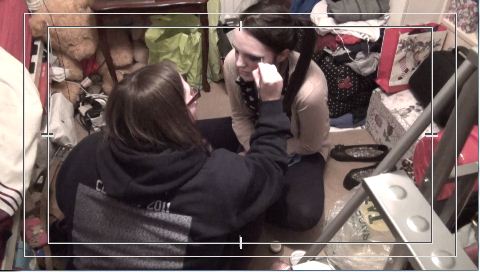
Before the filming day, we had already looked up on the internet, using google, on how to put on make up so it would look like a creepy doll. After finding the make up needed, we started to do the makeover in Dolly Pocket's face, played by Chloe Ravenscroft. 
Pictures from the transition:
The first thing we did, was painting her face all white, on this way we took away all the natural and good colour a human usually have in its face, and made it more ghostly. We did this as stereotypically ghosts are horror creatures. After this, she got some black eyeshaddow, both over and under her eyes. By adding these two effects, we made her look more scary and dead, and she was now closer to reveal her true nature.

After this we added big pink cheeks to her face. This was to create the image of a porcelain doll, to show how far Dolly Pockets obsession has gone. This indicates a very bad mental state


When the pale white skin, the black eyes and the red cheeks were all finished, we had to make her even more scary to get the horrifying effect we longed for. We therefore, as planned, gave her creepy black lips. The black lips gave the missing effect we wanted, and after them she looked like a mix of a half dead demon and a terrifying doll in her fac. We felt this truly revealed her true nature.


This is a picture of the ending result of Dolly Pocket after she has become an insane murderer.
As you can see we also chose to put her hair into pigtail. This was to reinforce the idea of Dolly's doll image as it is a very childish hairstyle, which adult generally do not wear.

As we started to film the ending scene of our film, we had to do something with the living room she was in. In the first scene it was very white and pure, now however, we wanted it to be more dark and eerie, but at the same time show that it was the same living room she was in. We wanted this change because the character had gone through a huge change in personality and in the way she looked. 
We therefore turned the light down, so the whole room was darker, this gave an immediate effect, however, we both knew that we needed to edit these shots in an editing program when we came back to school. This was because we both wanted the room to be even darker, wich would create a bigger sense of scariness and danger.  It will therefore not be natural lighting in any of the shots from the ending scene.
The props used in this scene is one knife with blood one. This is suppose to be the knife Dolly Pocket killed Tanya with. We can see her comming in with it, in a long shot, filmed in a low angle. The low angle gives Dolly more dominance. 
We also used a numerous toys, which Dolly sits on, with her dead baby. This is filmed in a long shot, as we can see her whole body.
We also had to use a blanket, where the 'baby' is laying in. In a over the shoulder shot filmed in a high angle, however we can see that there is no baby. This is the shot which reveals that Dolly Pocket really is insane, as she is singing to a blank blanket, believing her baby really lies there.
The costume for this scene, is, as you can see on the picture, very different from Dolly Pocket's costume from scene one. In this scene she uses a green doll dress, with white circles all over it. We thought this costume would give a creepy feeling, because it is suppose to be used in a cute way, possible young children using it, while they are happy and out with friends.In our film however, it is used while she is killing other people and is obsessed by her own dead child. This challenges people view over a doll costume.

Scene 2.
As we had finished up both scene one, and the ending scene we figured we had good time on us, so we started filming scene two. This is a very short scene we only needed to film Dolly Pocket in her doll costume taking up her knife and walking out the door, foreshaddowing she was going to kill someone. This was all done from the tripod, were we used medium shots. Because the room was still to light, we figured we also had to edit this in an editing program when we came back to school. Therefore it will not be natural lighting, but the location, setting and costume are still the same. The only prop we used for this scene, was the knife.

Friday, 3 February 2012

Task 9. Filming

Before we start to film, my group made a production schedule, where we planned out when, where, what, etc we were going to film, to make it easier for us on the actual filming day.

Our production schedule:


Wednesday, 1 February 2012

Task 7 and 8: Role allocation and casting

Task 7: Role allocation


In my group we have split the different tasks between each other like this:


Cameraperson: Frida

Writer: Frida and Chloe

Editor: Frida and Chloe

Director: Frida and Chloe

make up and costume artist: Liz Ravenscroft


Actors: Chloe Ravenscroft as Dolly Pocket
              Sophie Ravenscroft as Tanya


Task 8. Casting

In our film we need two actors. One actor to play Dolly Pocket, the antagonist in the film, and one actor to play Tanya, which is the victim in the opening sequence of Peek-A-Boo.
The props Tanya need for the film is a baby pram and formal clothes, this character is going to be played by Sophie Ravenscroft.
The props Dolly Pocket will need is toys, doll costume, bones and a plastic knife. This character has been decided to be played by Chloe Ravenscroft.

We choosed the name Tanya to the victim as it is just a casual working/middle class name, with no linking to anything special. On this way it shows that Tanya is just a regular woman, with no special qualifications. In the film as a whole, she does not have much to say, except from showing, by her death, that Dolly Pocket is a brutal murderer.

We also choosed the name Dolly Pocket because this is more unusual. This indicates that there is something special and different about her. We specifically choosed the name 'Dolly' because in the film she is obsessed by her dead baby, and we often find her sitting amongst many dolls and other toys. The connotations to a doll, and therefore maybe 'Dolly' as well, are happy, children playing, light and safe enviroment. Since this is not the case in our film, it makes it even more twisted and disturbed. On this way we are also crossing people's expectations related to the name.

Storyboard

The purpose of a storyboard in general is to photograph (draw/digitalised) each and every shot that is going to appear in the film which involves a list of key information written underneath each shot. Storyboards allow the director of a film to visualise the whole film even before they have started filming and the storyboard allows the cameraman shooting the film to understand how the film should be shot. The befits of this is it allows you to change elements of the film and its shots if they don't seem to work visually before the expensive filming  process has begun. the frame of a storyboard shout contain -
The shot number- each shot must be numbered so the intended sequence of shots can be followed.


Framing- Whether the shot will be a close up for example or a medium long shot.


Drawing- So there is a visual image of what is happening in the shot.


Action- This is a brief description of whats happening in the shot.


Dialogue - Single lines may be written in order to understand in what shots dialogue is needed.


Sound effect- This is if their is any specific sounds diegetic and non diegetic.


Abbreviations can be used.
Therefore before making the opening of our horror film we have storyboarded the opening sequence in order to make the filming process as easy as possible and so we are organised and know what is needed when it comes to collecting/filming our footage


Our storyboard for Peek-A-Boo

Wednesday, 25 January 2012

Character profile

Every film made has one main character, and one or more major characters. The main character is generally always the protagonist which is the hero of the film, however, in our film the main character is the antagonist which is the villain. Our main character is Dolly pocket. She is a serial killer, as you may recognize from the picture below. The major characters in the opening scene is Tanya and her baby, sadly they are the victims of Dolly pocket in our two minute film; Peek -a -boo. 


Main character, Dolly Pocket:

Name: Dolly Pocket

Age: 25

Gender: Female

Occupation: Unemployed, serial killer.

Appearance/costume: Dolly's clothes are in the colours pink, red and black. Black hair in ponytails. White skin, red cheeks, black around her eyes. 

Characteristics: Jealous, psychopath, angry, disillusioned and revenge seeking.  


Major character, Tanya:


Name: Tanya

Age: 26

Gender: Female


Occupation: Nurse and mother

Appearance/costume: Tanya wears tidy appropriate clothes that are comfortable. Her hair is in a short cropped hairstyle for efficiency. She wears smart glasses and natural make up and in general has a gentle look about her

Characteristics:
Tanya is a kind, maternal, loving character that is hugely good natured. The opposite to Dolly Pocket.

Tuesday, 24 January 2012

Task 4. Film certificates


When a film has been made, it has also been made a rating for it. This rating decides who can watch the film and not.
The once in power to decide what the rating it is going to be is British Board of Film Classification (BBFC). BBFC are responsible for the national classification and censorship of films within the United Kingdom. This organisation is non-governmental, and is funded by the film industry.
The different rating certificates films can get are:

Universal – This means that everyone can watch it, there is no age limit, and nothing unsuitable for children over 4.


Parental guidance – All ages admitted, however, there might be some unsuitable scenes for children under 8. E.g. sex/drugs references, violence if justified by context.


12A - This category was introduced in 2002, and only counts when the film is shown at the cinema. It means that the films under this category are considered unsuiteable for very young people. Those under the age of 12 years, are only aloud to watch the film if accompanied by an adult, who has to be at least 18 years old. The adult have to be with the one age 12 or under, at all times during the film. However, children under 12 are still not recommended to watch it, as it can contain discrimination, moderat swear words, mature themes, soft drugs, infrequent strong language and moderat violence/sex references.

12 - This category was introduced in 2002. When films are rated to be 12A, they have usually been rated at a 12 certificate for the VHS/DVD version. This, however, does not happen if there has been added any extra material that demands a higher rating. Those under the age of 12 are not aloud to rent or buy a 12/rated VHS. DVD, Blu-ray Disc, UMD or game.                                                                                        The films within this category may include moderat violence, infrequent use of strong language, infrequent drugs, brief nudity, and discreet sexual activity.

15 - This rating certificate means that only those aged over 15 are permitted to watch the film. Those under 15 are not aloud to buy or rent a 15-rated VHS, DVD, Blu-ray Disc, UMD or game, they can also not watch a 15-rated film in the cinema. Under this category the films might contain hard drugs, adult themes, undetailed sec activity, moderate-strong/sec references and strong language and on use of very strong language.  

18 - This rating certificat means that only people aged 18 and over can rent or buy an 18-rated VHS, DVD, Blu-ray Disc, UMD or game, or watch a film in the cinema with this rating.                                                           This category may contain strong violence/sex references along with strong sexual activity, no limits on bad language and scenes of strong real sex may be aloud if justified by the context.


The film we made, 'Peer-A-Boo', will be rated with a eighteen certificat. This is beacuse even though the gore and violence is not strong, there is an adult theme within the film. The fact that a innocent baby dies is a serious theme, and is not appropriate for younger audience than 18.
On top of this there is also a dark murder already in the opening scenes, and in the way the opening scenes stops, it indicates that the murdering is not finished. The fact that there is a dark murder, makes the film inappropriate for audience under 18 years old, as it can be disturbing for those below this age group.

Monday, 23 January 2012

Task 4. The pitch

4.1-4.2 In this task we were suppose to come up with four concepts for either horror, romcoms or thriller films. We were also suppose to outline the basic plot/storyline.

Peak A-BOO
Lady dresses up as a doll. She stalks parents with babies due to jealousy, because she has lost her own daughter.
Scene opens with close ups on doll, teddy bears, baby clothes, at first proper toys, and then toys and dolls with eyes ripped out and destroyed. When camera films a close up of a cot the scene dissolves into a dark night.
Creepy woman stalks a woman with her baby in a pram. 
We keep filming the shadows of the creepy woman, dressed as a doll, as she continuously says peak A-BOO. Last time she says it, she shouts it out and attacks the woman, ends up with killing her. And p o v of the baby in the dead mothers cot of the creepy doll face she carries on repeating peek a boo the camera dissolves again showing the same pov shot of the creepy doll women looking into a cot however you see from a long shot she is back home she picks up baby which is a skeleton sits in the teddy’s and cry’s and rocks the baby crying peek a boo titles boom on.

Trapped
Young children /teenagers knock on a creepy women’s house and ask if they can sleep over as they are lost and need a place to sleep. As they get directed into different rooms, toys begin to come alive and attack the teenager. Now the party of teenagers are unable to get out they need to find a way to escape fast as the old women begins to turn on them to!

Possessed
Man comes home from work, he gets possessed by evil spirit as he walks through his door, and the sprit has control over his mind and body. The spirit then kills the man’s wife. The sprit leaves the body when the job is done and the man is left shocked and confused at what has happened then the sprit attaches to another and keeps doing so until everyone is dead.
Run
The scene opens with freak accident with a group of drunken teenagers messing about near a lake. In the chaos a girl is brutally drowned and left for dead by friends the scene cuts to the present and you see a ghostly figure of the girl rise eerily from the daughter with a knife with red eyes ready to attack those who left her to die so terribly.

Conclusion
In conclusion we chose to make film number one; Peak A-BOO. This because it involved less people in the movie, this makes the film easier to produce, as it is hard to find actors that are willing to work and use their spare time needed for the movie to be made well. It also had the scariest and most twisted plotline, to keep the audience interested. We also felt that this idea had the most depth to the characters, so there was a wide range of possibilities to work with.

Friday, 20 January 2012

analysing the box office data for each genre on UK film council website

This table from the 2010 box office shows the amount of horror, thrillers and romance films released in that year. The results show that horror had the most releases in the year compared to the other genres inferring that the Uk audience most likely want to view horror films at the cinema more than say the romantic films as more horror films were released implying there is a larger demand for them. Making horror a good genre of film to make as it is suggested to be the most popular film for the Uk audience. However even though romance only had nineteen releases there gross profit was slightly higher than horror at 58.4 compared to horror which grossed 51.1. this may be however because in 2010 more key releases and anticipated films in the romantic genre were released in 2010, for example the most popular film for romance in 2010 was The twilight Saga this is a well-known franchise so more people are likely to go see it compared to new horrors that are fresh on the market as they are already fans of the previous films. Even though paranormal activity 2 is a sequel the fan base for the films are nowhere near as big as the Twilight Saga which is a international phenomenon.  
The next pie chart shows the average box office per site of each genre in 2010. The results show that the average box office per site was higher than the thriller and horror genres at 18,861 compared to 13,151 for thriller and 11,624 for horror. However horror still grossed more than thriller implying even though it was released at fewer venues where it was released the films did very well indeed. Taking this into consideration the results also suggest that horror is a profitable market as romance was released at more venues implying they can reach a wider range of people than horror and thriller and seems as horror only grossed slightly less than romance it implies the horror film is a good market to invest in as it still makes huge gross and is still in competition with other genres such as romance even though it does not necessarily get aired to as many people.

Results of horror questionnaire

Ten people answered the questionnaires on various questionnaires more than one answer was required
1) What age group of characters best suit a horror film? 
Teenagers = 9/10
Children=1/10


2) Do you expect to see violence and gore?
Yes=9/10
No=1/10


3) Who is your favourite evil horror character?
Michael Myers=1
Chuckie=1
Sprits in various films=2
Freddie Kruger=1
Hannibal lector =2
Pinhead=1
Preacher in poltergeist=1

4) Who is your favourite hero in a horror movie?
Van Helsing =3/10
Special agent graham=3/10
Unknown=2/10
Care worker in case 39=1/10
The victim in hostel=1/10


5) What kind of music do you expect to see in a horror film e.g. famous song/backing track?
Backing track=5/10
Loud music=1/10
Eerie/spooky music=3/10
Silence=1/10


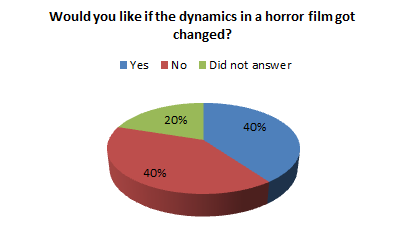
6)What do you think of changing gender dynamics in a horror film?
Yes=4/10
No=4/10
Do not know=2/10

7) How do you expect the title in a horror movie to appear e.gfast slow, big small and where on the screen and the effects present – fading in and out?
Fast=2
Slow=5
Fade in and out=7
Various effects=1
Big=6
Small=3
Centre position=3

8) What kinds of settings do you expect to see in a horror movie?
Bedroom=1
Dark backstreet=3
At work=0
Woods=6

9) What is your favourite horror movie?
Zombie land=1
Silence of the lambs=1
Dawn of the dead=1
Scream=1
Final destination =1
6th sense=2
Halloween=1
Jeepers creepers=1
Do not know=1

10) How do you expect the editing to be in a horror movie?
Twist=2
Sharp=2
Slow=1
Fast=2
Do not know=3

Analysis from the questionnaire
From the survey we have drawn the conclusion that most candidates liked teenagers and children as the main type of character in the horror film. This suggests that they liked the idea of innocence present in a character which is manipulated as children and teenagers are usually viewed as more innocent then adults as they are stereotypically less knowledgeable. Therefore suggesting when children and teenagers are the antagonist it is much more disturbing and wrong as it is unnatural.
A large number, nine out of ten, expected to see violence and gore in a horror film inferring that people associate a horror film with a lot of violence and acts of murder or pain. Whereas only one person voted no to violence and gore implying the idea that a horror film doesn’t necessarily have to contain violence and gore instead mental violence ,hurt and breakdown . implying not all horror s have to contain blood .   
The next two questions consisted of asking people there favourite hero and villain characters were in a horror film and why. There was a range of answers implying that a range of creatures or evil characters are viewed as equally scary in the horror genre. The reasons to why consisted of people feeling sensitive when the villain was a spirit for example saying they felt unprotected and unsure as the hero couldn’t protect themselves physically . other answers consisted that their favourite movie villains were people who had an appearance at first of purity but turned out evil e.g. Hannibal lector and Michael Myers who was a child at the beginning of a film this suggests that the audience like characters who appear as something they or not implying a sense of mystery is liked.
The heroes on the other hand such as Van Helsing were predominately male except for a few exceptions implying that a male character as the hero is viewed as most realistic as the reasons why consisted of strength and braveness something usually associated with the male gender opposed to female . However some people liked female heroes such as the case worker in case 39 suggesting sometimes a women hero is liked as it challenges the norms of a stereotypical horror film when the women is seen usually as the damsel in distress . This idea is reinforced on the gender dynamic question where 4 candidates like the idea of a women hero or villain with two not being fussed implying that the gender dynamics of women is a topic open to the public who are ready to embrace it.
People also voted that the music in a horror film should be a backing track opposed to a famous song containing as a backing track more spooky loud and eerie suggesting people found the music in a horror film important towards creating the scary horror setting.
The most popular setting for a horror film was the woods and a dark backstreet inferring that the audience liked places which were silent, dark and mysterious as both places are very good hiding places such as the woods where the antagonist can hide.
For our two minute film opening we have decided to make the opening of a horror film in order to prepare for this we made and sent out ten questionnaires based in horror dynamics in order to retrieve information on what an audience of a horror movies desire so when it comes to making and editing our film we have a clear idea of what will most appeal to our audience .

The majority of the questionnaire answerers seemed to prefer horror film titles that faded in and out and titles that were in the centre of the screen along with fading in and out slowly this inferring that there is a set particular style of titles that the audience like film makers to conform to that include the titles appearing slowly and fading in and out at the same time. It is implied in order to build u suspense and tension stereotypically. A majority of the questionnaire answerers also stated they like the idea of the titles appearing blood like suggesting gore is liked at the very beginning of the film rather than introduced slowly.

A range of horror films on question nine implied that a set type of horror film is not always desired by the audience and they like a range of films as each type of film had a different sub genre or very different characters from human to alien. This suggesting that our horror film does not necessarily need to stick to a certain type of horror film as the idea of variety is highlighted in this question.

The desired editing in a horror film varied greatly with some answerers confused at how they like to see a horror film edited however fast cuts were highly desired implying the audience like there horror films to be fast paced as the fast cuts create a sense of excitement and tension giving the impression the film is heading. This is something to consider when filming and editing our horror film . 

Pie chart results of questionnaire


Monday, 21 November 2011

Christian Metz model of genre development

Christian Metz in his book language and cinema (1974) explored the development of genre film and suggested that genres pass through four phases of existence.


1. The experimental
By experimental we mean the phase of early films which explored and experimented with the horror film genre themes in it's narratives.
Examples of experimental movies:


2. The classic
By classic we mean the phase of films which established the narrative conventions of the horror genre in its most successful and defining period.
Examples of classic horror movies:


3. Parody
By parody we mean films that have mimicked the horror genre in some comical way
Examples of parody horror movies:


4. Deconstruction
By deconstruction we mean films which have taken the generic elements of the horror genre and amalgamted them into varying sub genres.  
Examples of deconstructed horror movies.


Peter Cushing and Christopher Lee
Both Peter Cushing and Christoper Lee are famous horror films actors. They have played in films like Dracula (1931), Frankenstein (1931), Hound of the Baskervilles (1959) and The Mummy (1959) together.
           Peter Cushing                                                                    Christopher Lee